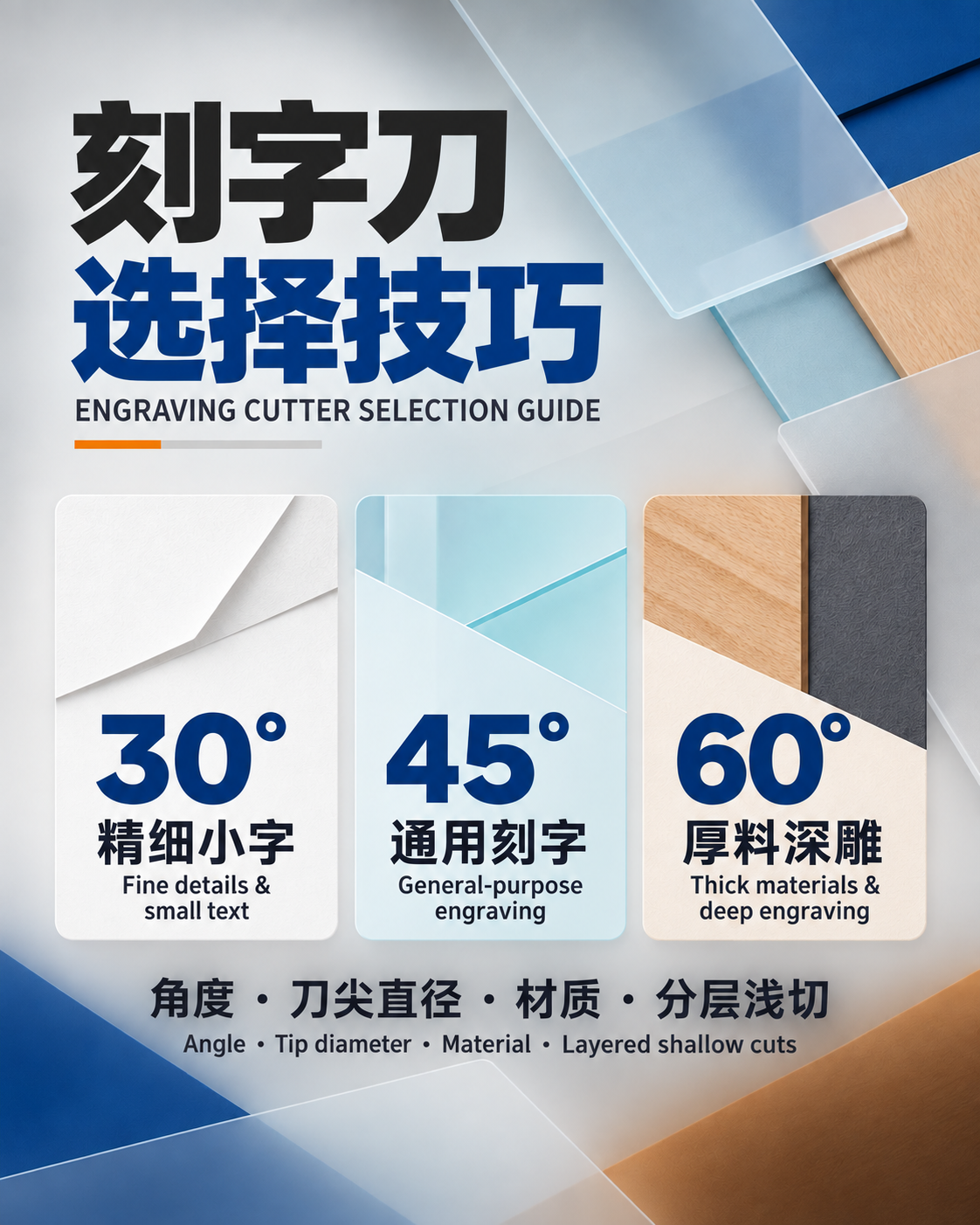
Choosing an engraving knife for engraving machines requires more than matching a shank diameter. The correct cutter must suit the workpiece material, letter size, engraving depth, spindle condition, and required edge detail. This practical guide explains how to select an engraving knife for clean signs, labels, molds, panels, and precision marking. JEEFOO supplies precision cutting tools from Guangzhou, China, for workshops, distributors, and CNC users worldwide.
Table of Contents
Table of Contents
What Is an Engraving Knife for Engraving Machines?
An engraving knife for engraving machines is a small precision tool designed to cut lines, letters, grooves, chamfers, and decorative details. Common forms include V-bits, flat-bottom engraving cutters, tapered cutters, and single-flute tools. Each geometry changes cutting force, chip evacuation, corner sharpness, and the width produced at a given depth.
Before choosing a cutter, confirm the machine type, collet size, spindle speed range, tool runout, and the rigidity of the workholding system. A rigid CNC router can use different feeds and depths from a light desktop engraver or vinyl cutting plotter. Correct tool selection protects the cutting edge and improves repeatability.
1. Match the Knife to the Engraved Material
Material is the first selection factor when choosing an engraving knife for engraving machines. Acrylic and other plastics need a sharp edge and good chip clearance to prevent melting. Aluminum and non-ferrous metals benefit from polished flutes, controlled chip load, and rigid clamping. Wood and MDF require an edge that clears dust efficiently while limiting tear-out. Laminates, PVC, foam board, and composite sheets may need different point angles or coatings.
- Acrylic and PVC: choose a sharp single-flute or polished engraving cutter and avoid excessive heat.
- Aluminum and brass: use carbide, low runout, lubrication when appropriate, and conservative depth per pass.
- Wood and MDF: select geometry that produces clean fibers and removes dust.
- Sign vinyl and thin films: use the specified blade angle and minimal exposed tip.
2. Consider Font Size and Detail
Small lettering needs a fine point, stable carbide, and very low runout. A large tip cannot reproduce narrow channels or tight internal corners. For larger letters and broad grooves, a stronger point or wider V-bit can remove material faster. Test the smallest stroke in the design and select a tip diameter that can enter it without rounding the detail.
For logos and fine line work, choose an engraving knife for engraving machines with consistent point geometry. Inspect the tool under magnification before production. Even a small chipped tip can widen letters, create burrs, or make repeated parts look different.
3. Select the Correct Point Angle
The point angle of an engraving knife for engraving machines matters: a narrow V-angle creates fine lines and reaches deeper into detailed artwork, but its point is more delicate. A wider angle produces a broader mark at the same depth and normally offers greater edge strength. Typical choices include 30-degree, 45-degree, 60-degree, and 90-degree engraving tools. The ideal angle depends on the design, material, and intended groove width.
Because V-groove width increases with cutting depth, uneven material surfaces can cause inconsistent lettering. Surface the spoilboard, secure the sheet, and use probing or height mapping when the application demands uniform line width.
4. Balance Engraving Depth and Tool Strength
Deep engraving places more side load on the tip. Use multiple passes instead of forcing a fragile cutter to full depth. A short cutting edge and minimum practical tool overhang improve stiffness. For deep channels, consider roughing with a stronger cutter and finishing with the selected engraving knife for engraving machines.
Depth should also match the purpose of an engraving knife for engraving machines. Surface marking may need only a light pass, while filled lettering, mold details, and decorative panels require a deeper groove. Always make a test cut before a production batch.
5. Check Shank Diameter and Collet Accuracy
The shank of an engraving knife for engraving machines must match the collet exactly. A mismatched or worn collet increases runout, vibration, noise, and premature breakage. Clean the collet, nut, spindle taper, and tool shank before installation. Do not clamp on the cutting flute, and keep overhang as short as the job allows.
6. Set Suitable Speed, Feed, and Chip Load
High spindle speed alone does not guarantee a clean finish. If feed is too low, the edge rubs and generates heat; if feed or depth is too high, the tip may deflect or break. Start with the tool supplier’s recommendation, then adjust using spindle power, cutter diameter, material hardness, and chip appearance. Chips should be removed from the cut rather than recut.
7. Evaluate Carbide Quality and Edge Finish
Micrograin carbide offers a useful balance of hardness, wear resistance, and toughness for precision engraving. Edge grinding quality is equally important. A smooth, symmetrical cutting edge reduces burrs and supports predictable dimensions. JEEFOO applies controlled manufacturing and inspection to engraving tools produced in Guangzhou, China, for demanding industrial applications.
Practical Selection Checklist
- Identify the exact material and thickness.
- Measure the smallest letter stroke or groove.
- Choose the tip diameter and point angle.
- Confirm shank and collet compatibility.
- Set minimum practical overhang.
- Begin with a shallow test pass.
- Inspect chips, edge quality, burrs, and heat.
- Record the final speed, feed, and depth for repeat jobs.
Why Source Engraving Tools from JEEFOO?
JEEFOO supports engraving, sign making, woodworking, acrylic fabrication, panel marking, and light metal machining. Based in Guangzhou, China, the company supplies precision cutters and practical application guidance for international customers. Explore more JEEFOO cutting tool guides or contact the team with your material, machine, shank size, angle, and required engraving depth.
For terminology and dimensional principles used across cutting tools, consult the ISO standards catalogue. Final parameters should always be verified with a controlled test cut on the actual machine and material.
Conclusion
The best engraving knife for engraving machines is the tool that matches the material, smallest detail, groove depth, machine rigidity, and collet system. Careful setup, controlled cutting parameters, and consistent carbide quality improve finish and tool life. For application-specific recommendations, JEEFOO in Guangzhou, China, can help match cutter geometry to your engraving process.